
Perspex Online

Wall Cladding ACM

Union | Perspex Online
cladding 1 | Perspex Online

Overview

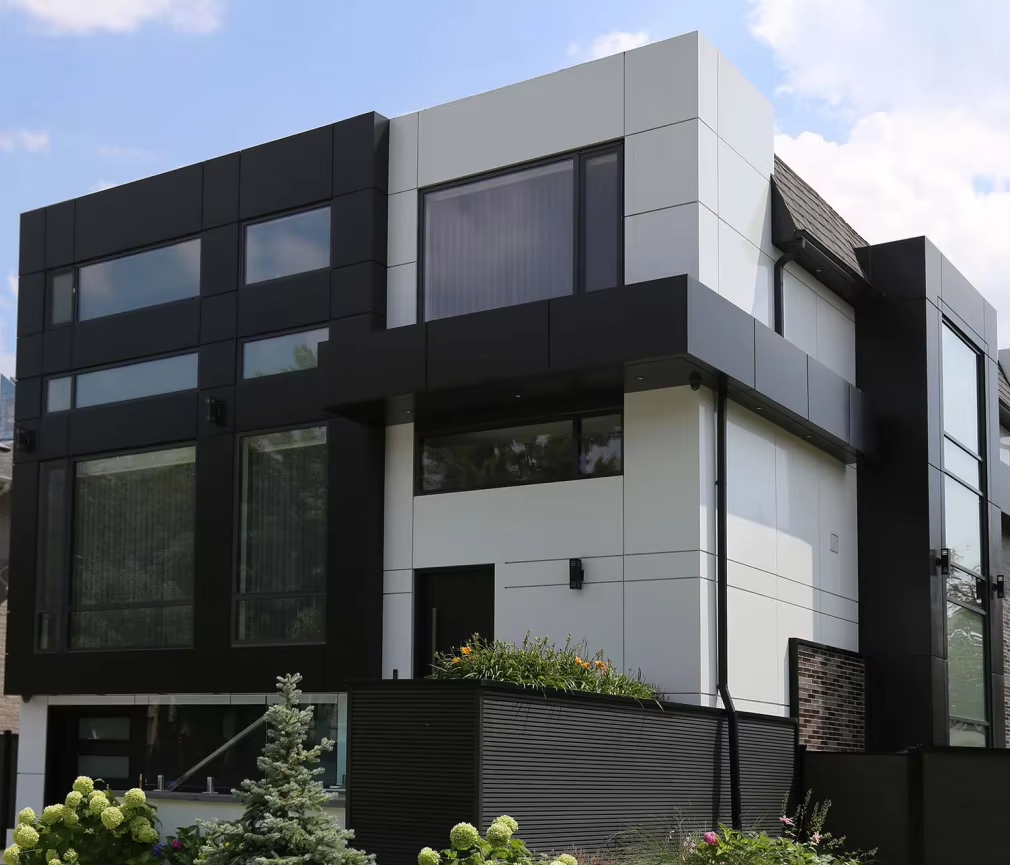
Aluminium Composite Material (ACM) wall cladding is used in commercial, industrial, and infrastructure projects for external façades, internal feature walls, column wraps, and soffits. ACM consists of aluminium skins bonded to a core material, providing a lightweight and rigid cladding solution suitable for modern construction systems.
In commercial construction, ACM panels are typically fabricated to architectural drawings and integrated with fixing rails, subframes, and structural supports. Panel sizing, joint spacing, edge returns, and fixing methods are defined during the design stage.
ACM is commonly specified where flatness, clean detailing, and reduced structural weight are required.

Typical Project Environments

ACM cladding is used across:

  • Commercial office buildings

  • Retail centres and shopfronts

  • Industrial facilities

  • Schools and public buildings

  • Transport terminals

  • Refurbishment and façade upgrades


Both new-build and retrofit façade projects may incorporate ACM panels.

cladding 2 | Perspex Online
cladding 3 | Perspex Online

Functional Objectives

ACM wall cladding systems are designed to:

  • Provide a clean architectural finish

  • Protect structural elements from weather exposure

  • Reduce overall façade weight

  • Allow modular panel replacement

  • Conceal services or substrate irregularities

  • Improve visual uniformity across large surfaces


Panel performance must align with structural, aesthetic, and compliance requirements.

Recommended Materials for Wear Strips

Popular Wall Cladding ACM

Performance Requirements

Mechanical

  • Panel rigidity across fixing spans

  • Resistance to oil-canning (surface distortion)

  • Secure fixing to subframes

  • Edge stability after routing and folding

  • Wind load resistance


Environmental

  • UV stability and colour retention

  • Resistance to moisture ingress

  • Thermal expansion management

  • Corrosion resistance in coastal or industrial areas

Panel Configurations

ACM cladding panels may be supplied as:

  • Flat cut panels

  • Routed and folded cassette panels

  • Column wraps

  • Feature wall panels

  • Signage backing panels

  • Perforated decorative panels


Cassette-style panels are commonly used in façade systems to allow concealed fixing and modular installation.

Material Options

ACM panels are available in various core types depending on compliance requirements:


Standard Core ACM

  • General façade and internal applications

  • Lightweight and rigid


Fire-Retardant (FR) Core ACM

  • Designed to meet stricter building code requirements

  • Suitable for many commercial applications


Non-Combustible Core Panels

  • Used where compliance requires higher fire performance


Core selection must align with current building regulations and project specification.

Fabrication & Processing

ACM cladding panels are processed using:

  • CNC routing for precise profiling

  • V-grooving for folding and cassette formation

  • Cutting to architectural dimensions

  • Drilling and slotting for fixing systems

  • Edge finishing


Plastic fabrication capabilities may be integrated where ACM panels interface with HDPE, polycarbonate, or acrylic components.


Laser cutting may be used for decorative perforations depending on thickness and finish.

truck liners1 | Perspex Online

Alternative Options:

All components used in this application are manufactured in-house using controlled, drawing-led production processes. We do not supply generic or off-the-shelf products. Each part is produced to specification to meet defined mechanical, environmental, and installation requirements.

Frequently Asked Questions

Are ACM panels supplied cut to size? +

Yes, panels are CNC cut to architectural drawings and specified dimensions.

Can panels be folded into cassette form? +

Yes, V-grooving and folding processes are used to create cassette-style panels.

What core type should be specified? +

Core selection depends on fire compliance requirements and project documentation.

Are panels suitable for coastal environments? +

Yes, provided appropriate finishes and fixing systems are selected.

Can custom colours be supplied? +

Panel availability depends on manufacturer range and project specification.

How is thermal expansion managed? +

Fixing systems and joint spacing must allow for movement across panel length.

Send Us Your Drawing

Selecting the correct material and fabrication approach for automotive and fleet applications requires consideration of load type, environment, installation method, and service life expectations.