
Dust Covers
Overview
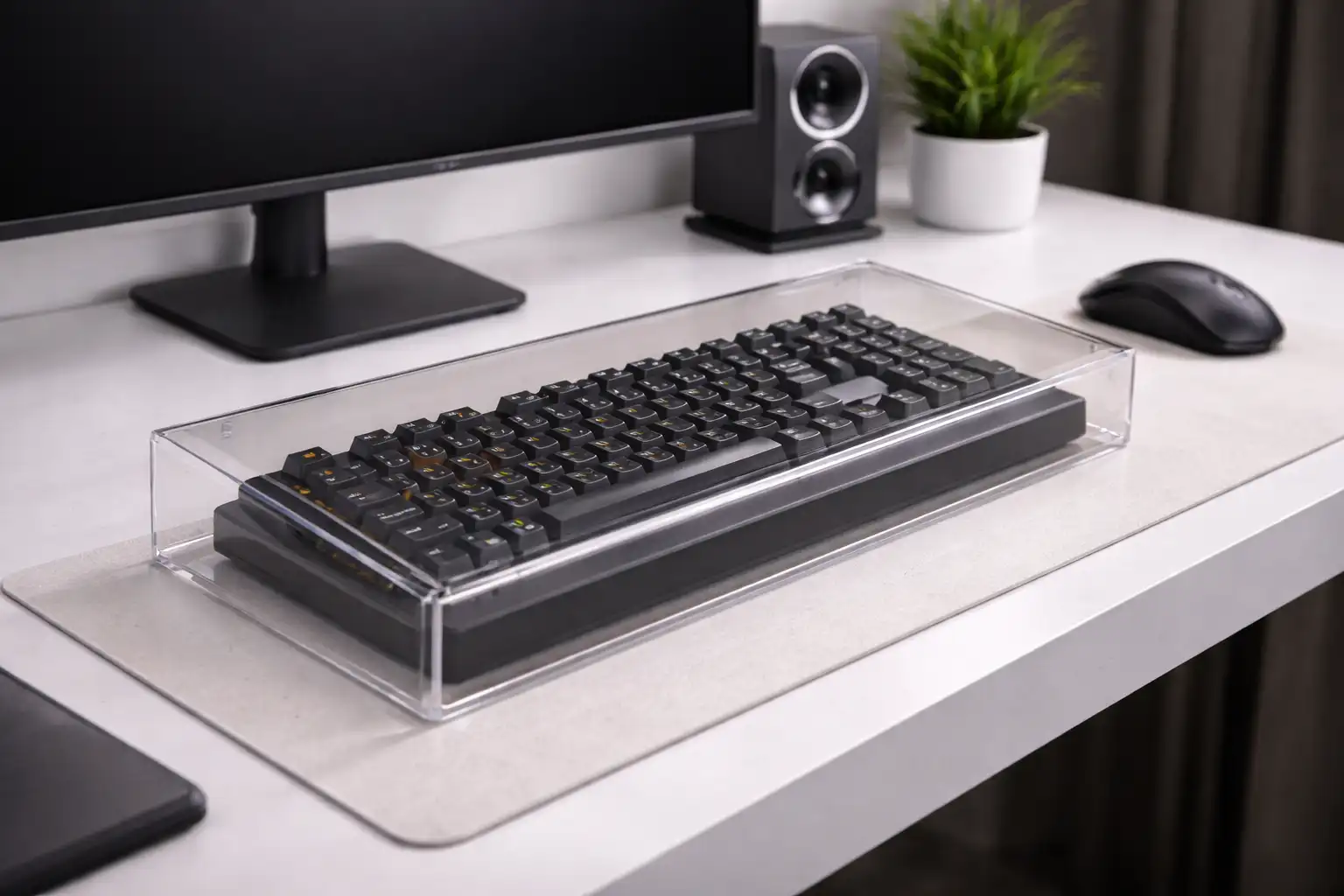
Dust covers are transparent or opaque protective enclosures used to shield products, equipment, or display items from dust, debris, and handling while maintaining visibility where required. In retail and display environments, dust covers are commonly fabricated from clear plastic panels to protect merchandise while allowing customers to view products clearly.
These covers are widely used in:
Retail display cases and showroom environments
Exhibition and trade show displays
Museum and gallery displays
Electronics and technology product displays
Industrial showroom equipment displays
Plastic materials are frequently used for dust covers because they offer clarity, lightweight construction, and fabrication flexibility. Compared with glass, plastic panels are easier to machine, less prone to breakage, and can be fabricated into custom shapes to fit specific display or equipment dimensions.
Custom Manufactured to Your Drawings
Dust covers are rarely standard sizes. They are normally produced to fit specific products, equipment, or display fixtures.
We manufacture dust covers based on:
CAD drawings or technical design files
Customer sketches or reference dimensions
Physical samples of existing covers
Prototype and one-off units
Repeat production runs for retail or commercial environments
All components are fabricated in-house using precision cutting and machining processes. Because cover dimensions, openings, and mounting requirements vary widely, most dust covers are custom-built from customer drawings.
Typical Applications
Dust covers are used across a wide range of display and protection applications, including:
Retail product protection covers
Electronics display protection covers
Museum artefact dust protection cases
Exhibition display covers
Equipment protection covers for showrooms
Collectible or memorabilia display protection
Countertop display dust shields
Machinery showroom protection covers
In many of these applications, the cover must balance product visibility with environmental protection.
Recommended Materials for Dust Covers
Popular Dust Covers
-
ABS Plastic Sheet
$113.54 – $340.00Price range: $113.54 through $340.00 Select options This product has multiple variants. The options may be chosen on the product page -
Acrylic Sheet (Perspex)
$60.00 – $2,358.00Price range: $60.00 through $2,358.00 Select options This product has multiple variants. The options may be chosen on the product page -
Polycarbonate Sheet (UV Resistant)
$101.20 – $2,541.50Price range: $101.20 through $2,541.50 Select options This product has multiple variants. The options may be chosen on the product page -
Rigid PVC Sheet
$40.43 – $2,177.60Price range: $40.43 through $2,177.60 Select options This product has multiple variants. The options may be chosen on the product page
Key Performance Requirements
Mechanical
Dust covers must provide structural stability while maintaining clarity.
Typical mechanical considerations include:
Adequate panel rigidity
Clean bonded joints or assembled edges
Scratch resistance for display surfaces
Smooth polished edges for visible installations
Stability when placed over displayed items
Environmental
Dust covers are typically used in indoor environments but may still face environmental exposure.
Considerations include:
Resistance to yellowing under indoor lighting
Compatibility with cleaning agents
Long-term clarity and transparency
Protection against dust and airborne particles
Recommended Materials
Acrylic (PMMA)
The most commonly used material for dust covers due to its excellent transparency and polished appearance.
Advantages:
High optical clarity
Lightweight compared with glass
Easy to machine and polish
Limitations:
Lower impact resistance compared with polycarbonate
Polycarbonate
Used where greater durability or impact resistance is required.
Advantages:
Very high impact resistance
Suitable for high-traffic public areas
Limitations:
Slightly lower optical clarity
More susceptible to surface scratching
Material Selection Summary
For most retail and display dust covers, acrylic is preferred due to its optical clarity and premium finish. It provides a glass-like appearance while remaining lighter and easier to fabricate.
Polycarbonate may be selected where higher impact resistance is required, particularly in environments with frequent handling or potential impact.
PETG can be used when thermoformed shapes or curved covers are required, although it does not typically offer the same scratch resistance as acrylic.
Material selection should consider visibility requirements, exposure to handling, and cover size.
Design & Installation Considerations
Several factors should be considered when designing dust covers:
Overall cover dimensions and panel thickness
Access requirements for removing the cover
Clearance between the cover and displayed items
Ventilation openings where required
Edge finishing for visible display areas
Stability when placed on display bases
Careful design ensures that the cover protects the displayed item without obstructing visibility or access.
Alternative Options:
All components used in this application are manufactured in-house using controlled, drawing-led production processes. We do not supply generic or off-the-shelf products. Each part is produced to specification to meet defined mechanical, environmental, and installation requirements.
Frequently Asked Questions
Dust covers are commonly fabricated from 3 mm to 8 mm acrylic, depending on size and rigidity requirements.
Yes. Most dust covers are manufactured from CAD drawings, sketches, or reference dimensions.
Yes. Dust covers are typically custom fabricated to match the size of the equipment or display item.
Yes. Ventilation slots or drilled holes can be included during fabrication if required.
Yes. Curved covers may be produced using thermoforming processes, depending on material selection.
Yes. Clear acrylic dust covers are widely used to protect retail merchandise while maintaining product visibility.