
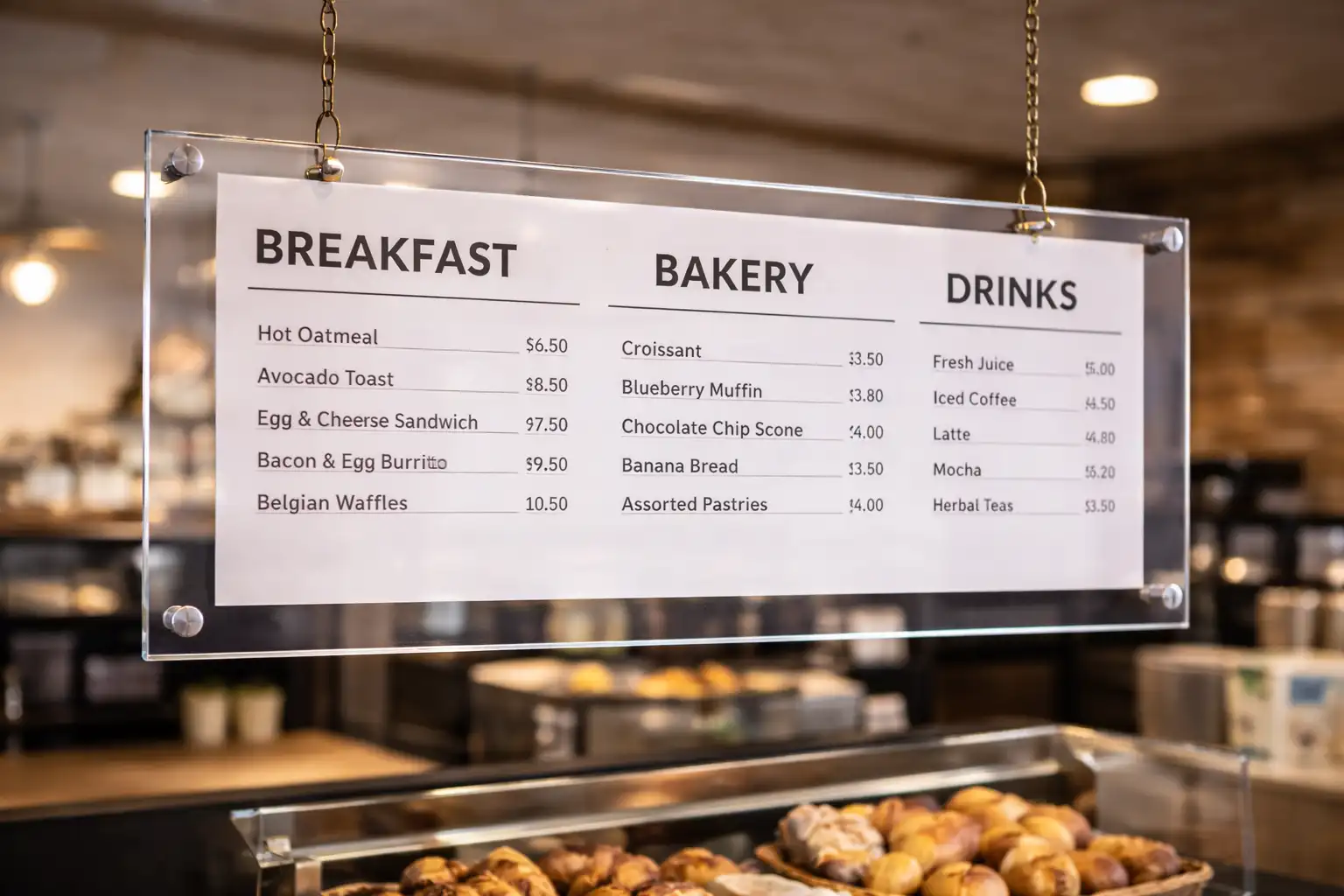
Menu Boards
Overview
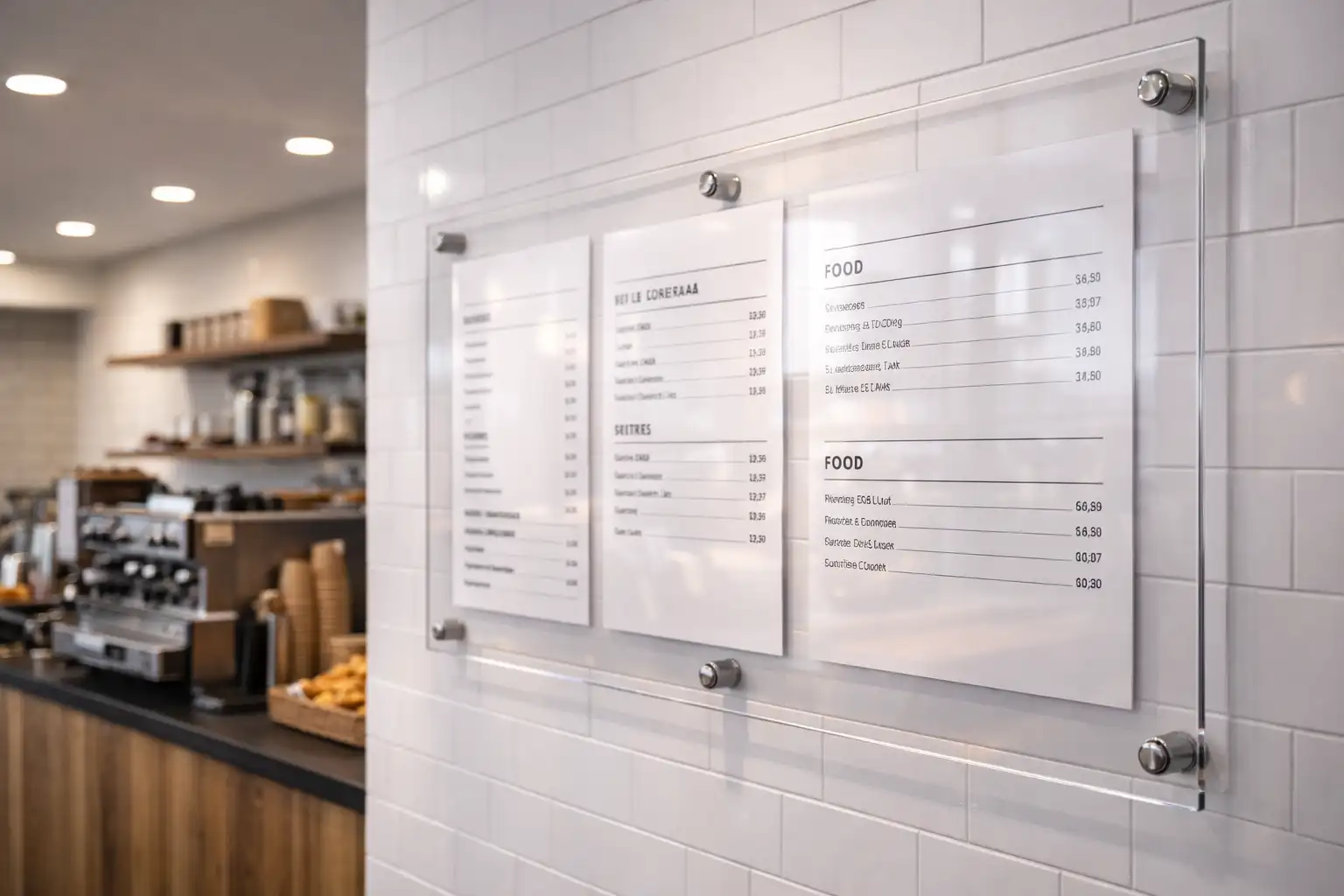
Menu boards are display panels used to present product offerings, pricing, and promotional information in hospitality, food service, and retail environments. These boards are typically mounted behind service counters, on walls, or integrated into freestanding display structures where customers can easily view menu items.
Menu boards are commonly used in:
Restaurants and cafés
Quick service and takeaway outlets
Food courts and commercial kitchens
Bars and hospitality venues
Retail food counters and bakeries
Because menu boards must integrate with store layouts, lighting systems, and branding requirements, they are often custom manufactured to specific dimensions and mounting configurations.
Custom Manufactured to Your Drawings
Menu board panels and components are typically produced to match specific display systems or architectural installations.
We manufacture menu board components from:
CAD drawings or design files
Customer sketches or layout specifications
Reference samples or existing display panels
Prototype units for new store fit-outs
Repeat production runs for chain locations
All components are fabricated in-house using precision machining and fabrication processes. Mounting holes, cut-outs, and panel dimensions are produced according to the drawing requirements.
Because menu board sizes, lighting systems, and mounting structures vary widely, most panels are drawing-led custom fabrications rather than standardised products.
Typical Applications
Menu boards are used across a range of commercial food service and retail environments, including:
Wall-mounted restaurant menu boards
Backlit café or coffee shop menu panels
Quick service restaurant menu displays
Retail food counter pricing boards
Drive-through menu display panels
Changeable insert menu systems
Hospitality promotional boards
Countertop menu information panels
These applications require materials that provide clear visibility, durability, and compatibility with lighting systems.
Recommended Materials for Menu Boards
Popular Menu Boards
-
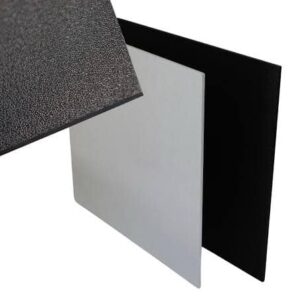
ABS Plastic Sheet
$113.54 – $340.00Price range: $113.54 through $340.00 Select options This product has multiple variants. The options may be chosen on the product page -
Acrylic Sheet (Perspex)
$60.00 – $2,672.40Price range: $60.00 through $2,672.40 Select options This product has multiple variants. The options may be chosen on the product page -
Polycarbonate Sheet (UV Resistant)
$101.20 – $3,396.60Price range: $101.20 through $3,396.60 Select options This product has multiple variants. The options may be chosen on the product page -
Rigid PVC Sheet
$40.43 – $2,177.60Price range: $40.43 through $2,177.60 Select options This product has multiple variants. The options may be chosen on the product page
Key Performance Requirements
Mechanical
Menu board panels must maintain structural stability and visual clarity.
Typical mechanical considerations include:
Panel rigidity for wall mounting
Clean edge finishing for visible installations
Dimensional accuracy for frame systems
Scratch resistance for long-term appearance
Stability for large panel formats
Environmental
Menu boards are often exposed to lighting and cleaning conditions.
Environmental considerations include:
UV stability under strong indoor lighting
Resistance to yellowing or discoloration
Compatibility with regular cleaning
Stability near warm food preparation environments
Recommended Materials
Acrylic (PMMA)
A common material for menu boards due to its excellent clarity and premium visual finish.
Advantages:
Glass-like transparency
Smooth surface suitable for printed graphics
Good compatibility with backlighting
Limitations:
Lower impact resistance than polycarbonate
Polycarbonate
Used where increased durability is required.
Advantages:
Very high impact resistance
Suitable for public-access environments
Limitations:
Slightly reduced optical clarity compared with acrylic
Surface scratches more easily
Material Selection Summary
For most hospitality menu boards, acrylic is preferred due to its optical clarity and compatibility with illuminated displays. Acrylic panels allow printed graphics or inserts to remain clearly visible while maintaining a professional appearance.
Polycarbonate may be used where impact resistance is required, particularly in busy public environments.
PETG may be selected for thermoformed or curved panels, although it typically offers lower scratch resistance than acrylic.
Material selection should consider lighting conditions, installation method, and durability requirements.
Design & Installation Considerations
Several design factors should be considered when producing menu boards:
Panel thickness relative to board size
Compatibility with backlighting or lightboxes
Mounting hole placement and spacing
Edge finishing for visible installations
Accessibility for changing menu graphics
Resistance to heat and lighting exposure
Proper design ensures that the menu board integrates smoothly with its display environment while maintaining long-term clarity.
Alternative Options:
All components used in this application are manufactured in-house using controlled, drawing-led production processes. We do not supply generic or off-the-shelf products. Each part is produced to specification to meet defined mechanical, environmental, and installation requirements.
Frequently Asked Questions
Menu boards commonly use 3 mm to 8 mm acrylic, depending on panel size and mounting system.
Yes. Most panels are manufactured from CAD drawings, sketches, or design layouts.
Yes. Acrylic panels are commonly used in backlit lightbox menu systems.
Yes. CNC machining allows accurate drilling of mounting holes and slots during fabrication.
Yes. Thermoforming processes can be used to create curved display panels where required.
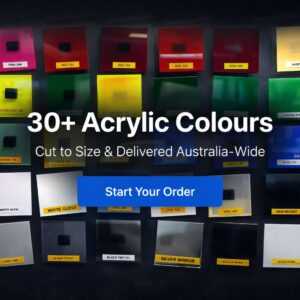
Yes. Acrylic and other plastics are available in clear, coloured, or frosted finishes.