
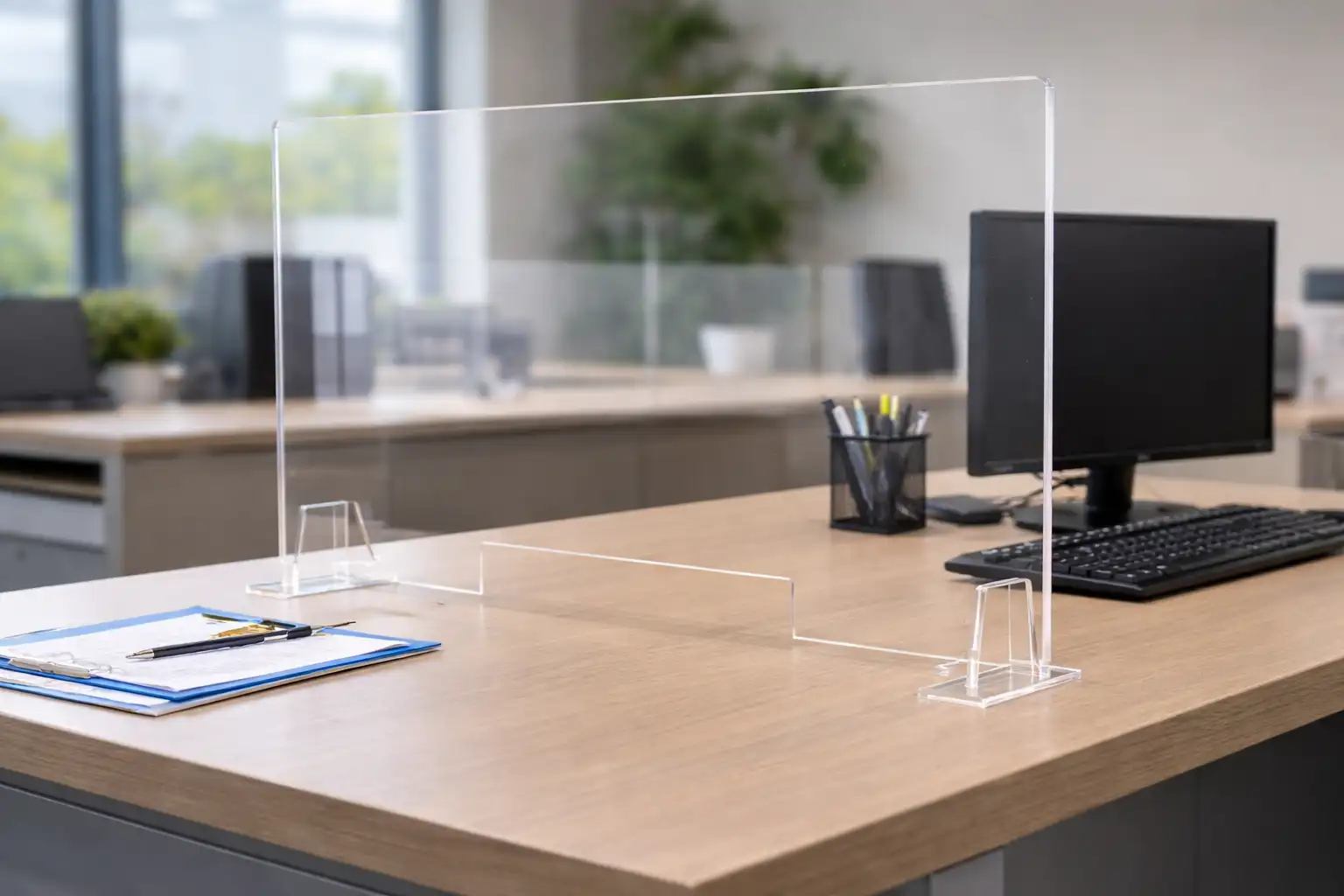
Safety Screens | Perspex Online

Perspex Online

Safety Screens

Union | Perspex Online
screens 1 | Perspex Online

Overview

Plastic materials are widely used for safety screens because they provide impact resistance, transparency, and fabrication flexibility. Clear plastics allow operators or staff to maintain visual monitoring of equipment, work areas, or customer interactions while remaining physically separated from hazards.


Safety screens are commonly used in:

  • Manufacturing and production facilities

  • Food processing environments

  • Laboratories and healthcare settings

  • Retail service counters

  • Warehousing and logistics facilities

  • Public service areas


Because safety screens must integrate with existing equipment layouts, workstations, or facility structures, they are typically custom manufactured to customer drawings or installation specifications.

Custom Manufactured to Your Drawings

Safety screens are usually designed to match specific equipment layouts, workstation sizes, or safety system requirements.


We manufacture safety screen panels from:

  • CAD drawings and technical specifications

  • Customer sketches or dimensional layouts

  • Reference samples of existing screens

  • Prototype panels for new safety installations

  • Repeat production runs for facilities or equipment systems


All panels are manufactured in-house using precision machining and fabrication processes. Mounting holes, cut-outs, and edge finishes are produced according to the supplied drawings.


Because installation environments vary significantly, safety screens are typically drawing-led custom fabrications rather than standard products.

screens 2 | Perspex Online
screens 3 | Perspex Online

Typical Applications

Safety screens are used in a variety of environments where separation and visibility are required, including:

  • Machine operator safety screens

  • Laboratory splash protection panels

  • Food preparation area hygiene screens

  • Retail service counter protective screens

  • Equipment workstation safety barriers

  • Production line operator protection panels

  • Cleanroom workstation screens

  • Reception or service desk protective panels


These applications require materials that provide visibility, durability, and reliable protective performance.

Recommended Materials for Safety Screens

Popular Safety Screens

Key Performance Requirements

Mechanical

Safety screens must provide structural stability and effective protection.


Typical mechanical considerations include:

  • High impact resistance for protective barriers

  • Panel rigidity to prevent flexing

  • Smooth edges for safe installation and handling

  • Secure mounting features for fixed installations

  • Dimensional accuracy for integration with equipment


Environmental

Safety screens may be exposed to lighting, cleaning agents, or operational conditions.


Environmental considerations include:

  • Resistance to cleaning chemicals and disinfectants

  • UV stability under indoor lighting

  • Long-term clarity and transparency

  • Resistance to scratching or surface damage

Recommended Materials

Polycarbonate

A common choice for safety screens due to its exceptional impact resistance.


Advantages:

  • Very high strength and durability

  • Suitable for high-risk safety environments

  • Maintains transparency while providing protection

Limitations:

  • Slightly lower optical clarity than acrylic

  • Surface can scratch more easily


Acrylic (PMMA)

Used where clarity and visual presentation are important.


Advantages:

  • Excellent optical clarity

  • Smooth and polished surface finish

  • Lightweight compared with glass

Limitations:

  • Lower impact resistance than polycarbonate

Material Selection Summary

For safety screens exposed to impact risks or industrial environments, polycarbonate is often preferred because of its high strength and durability.


Where optical clarity and presentation are priorities, acrylic may be used, particularly in lower-risk environments such as service counters or reception areas.


PETG may be selected when formed or curved screens are required, although it typically offers lower surface hardness than acrylic.


Material selection should consider impact risk, installation environment, and required transparency.

Design & Installation Considerations

When designing safety screens, several factors should be considered:

  • Panel thickness relative to size and impact risk

  • Mounting method and support structures

  • Clear visibility of equipment or work areas

  • Access openings for equipment operation

  • Compatibility with cleaning and hygiene requirements

  • Long-term durability in the operating environment


Careful design ensures that the screen provides effective protection without interfering with workflow or equipment operation.

screen 4 | Perspex Online

Alternative Options:

All components used in this application are manufactured in-house using controlled, drawing-led production processes. We do not supply generic or off-the-shelf products. Each part is produced to specification to meet defined mechanical, environmental, and installation requirements.

Frequently Asked Questions

What materials are commonly used for safety screens? +

Common materials include polycarbonate, acrylic, and PETG, depending on the required level of impact resistance and transparency.

What thickness plastic is typically used for safety screens? +

Safety screens commonly use 4 mm to 10 mm plastic sheets, depending on panel size and protection requirements.

Can safety screens be produced from custom drawings? +

Yes. Most safety screens are manufactured from CAD drawings, sketches, or installation specifications.

When should polycarbonate be used instead of acrylic? +

Polycarbonate should be used where high impact resistance is required, particularly in industrial or machine safety applications.

Can mounting holes or cut-outs be included? +

Yes. CNC machining allows accurate drilling of mounting holes and cut-outs during fabrication.

Are curved safety screens possible? +

Yes. Thermoforming processes can be used to create curved protective panels.

Send Us Your Drawing

Selecting the correct material and fabrication approach for automotive and fleet applications requires consideration of load type, environment, installation method, and service life expectations.