

Conveyor Belts
Conveyor belts fail for one simple reason: wear. Friction, abrasion, impact, moisture, and contamination slowly destroy metal components and belts, driving up downtime and maintenance costs. That is why plastic wearable parts on conveyor belts are now standard across food processing, packaging, mining, recycling, and manufacturing lines.
This guide breaks down where plastic wear parts are used, which plastic materials actually perform, and how to select the right thickness and sheet type—with a practical focus on ordering cut-to-size plastic sheets for fast replacement.

Where Plastic Wear Parts Are Used on Conveyor Belts
Plastic wear components are installed anywhere a belt, chain, or product slides, rubs, or impacts a surface.
Common Conveyor Wear Applications
- Wear strips and wear rails
- Chain guides and tracks
- Slider beds and belt supports
- Side guides and product rails
- Impact pads and transfer liners
- Scrapers and belt cleaners
These parts are sacrificial by design: they wear out instead of the belt or conveyor frame.
Why Plastic Outperforms Metal in Wear Applications
Metal-on-belt contact creates heat, noise, and accelerated belt wear. Plastics solve these problems.
Key Advantages of Plastic Wear Parts
-
- Low friction – reduced power draw and belt wear
-
- Noise reduction – critical in packaging and food plants
-
- Corrosion resistance – ideal for washdown and outdoor use
-
- No lubrication required – cleaner, safer operation
-
- Easier replacement – lighter and simpler to machine
For most conveyor systems, plastic wear parts are cheaper over their lifecycle than steel or aluminium.
Best Plastic Materials for Conveyor Wear Parts
Choosing the wrong plastic costs money fast. Below is a practical comparison of the plastics actually used on conveyor belts.
UHMWPE (Ultra High Molecular Weight Polyethylene)
Industry standard for wear
Used for:
- Wear strips
- Chain guides
- Curved tracks
- Impact liners
Why it works:
- Extremely low friction
- Excellent abrasion resistance
- Self-lubricating
- Quiet under load
Limitations:
- Not structural
- Soft compared to engineering plastics
HDPE (High-Density Polyethylene)
Cost-effective wear solution
Used for:
- Wear rails
- Side guides
- Light-duty liners
Why it works:
- Good wear resistance
- Lower cost than UHMWPE
- Easy to machine
Limitations:
- Shorter wear life than UHMWPE
- Not ideal for high-speed or high-load conveyors
Acetal (POM)
Precision and low friction
Used for:
- Chain tracks
- High-speed straight runs
- Tight tolerance components
Why it works:
- Very low friction
- High stiffness
- Excellent dimensional stability
Limitations:
- Higher cost
- Less impact resistance than UHMWPE
Nylon
Strength-focused applications
Used for:
- Rollers
- Structural wear blocks
Why it works:
- High load capacity
- Tough and rigid
Limitations:
- Absorbs moisture
- Can squeak or bind without lubrication
UHMWPE vs HDPE for Conveyor Wear Parts
| Feature | UHMWPE | HDPE |
|---|---|---|
| Wear resistance | Excellent | Good |
| Friction | Very low | Low |
| Noise | Very quiet | Quiet |
| Cost | Higher | Lower |
| Best use | High wear zones | Light–medium wear |
Bottom line:
If the part slides constantly or sits under a belt or chain, UHMWPE is usually worth the extra cost.
-

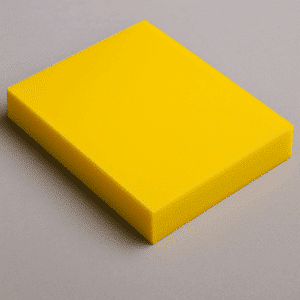
Yellow HDPE Sheet
$343.80 – $1,265.40Price range: $343.80 through $1,265.40 Select options This product has multiple variants. The options may be chosen on the product page -
Seaboard HDPE (Marine Plastic)
$350.96 – $1,348.73Price range: $350.96 through $1,348.73 Select options This product has multiple variants. The options may be chosen on the product page -
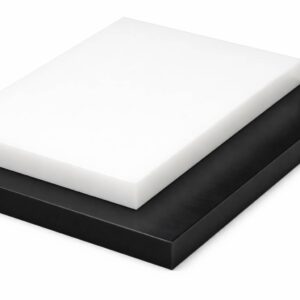
UHMWPE Sheet
$402.93 – $4,757.72Price range: $402.93 through $4,757.72 Select options This product has multiple variants. The options may be chosen on the product page -
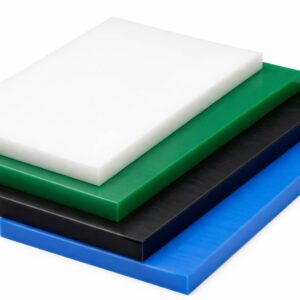
HDPE Sheet
$60.00 – $6,076.00Price range: $60.00 through $6,076.00 Select options This product has multiple variants. The options may be chosen on the product page

Thickness Selection: What Actually Works
Thickness selection is not guesswork. It depends on load, span, and wear rate.
Typical Thickness Guide
- 6–10 mm – Side guides, light wear strips
- 12–15 mm – Standard wear rails and chain guides
- 20–25 mm – Slider beds, impact areas
- 30+ mm – Heavy-duty liners and transfer points
Too thin and the part wears through prematurely. Too thick and you waste money and space.
Ordering cut-to-size plastic sheets allows you to match thickness precisely to the application.
Indoor vs Outdoor Conveyor Applications
Indoor Conveyors
- UV resistance less critical
- Focus on wear rate and noise
- UHMWPE, HDPE, and acetal all suitable
Outdoor Conveyors
Plastic wear parts outperform metal outdoors due to corrosion resistance and reduced maintenance.
Why Ordering Cut-to-Size Plastic Matters
Buying full sheets and cutting in-house wastes time and material. Conveyor wear parts are dimension-critical.
Benefits of Cut-to-Size Plastic Sheets
- Exact fit every time
- Reduced installation time
- Less material waste
- Faster maintenance turnarounds
With an online calculator, you can price parts instantly and order replacements before failures occur.
Real-World Conveyor Applications
Plastic wearable parts are used daily in:
- Food and beverage packaging lines
- Mining and bulk material conveyors
- Recycling facilities
- Warehousing and logistics systems
- Pharmaceutical production
In each case, plastics extend belt life and reduce downtime.
Final Buying Advice
If you are replacing or upgrading conveyor wear parts:
- Identify sliding vs impact zones
- Choose UHMWPE for high wear, HDPE for lighter duty
- Select thickness based on load, not guesswork
- Order parts cut to size to avoid delays
Plastic wear parts are consumables. The goal is predictable replacement—not failure.
Ready to Order Conveyor Wear Plastics?
Get exact pricing, exact sizing, and fast turnaround from an Australian supplier.
Use the cut-to-size calculator on perspexonline.com.au
Order UHMWPE or HDPE sheets cut to your exact dimensions